Showing posts with label crossover books. Show all posts

Tuesday, March 22, 2011

Weekend (and Crossover) Reviews


Here are the (late) YA/Crossover reviews from major media sources, March 14-20:

Monica and Hannah McRae Young review books for young readers in the Winston-Salem Journal.  They provide capsule reviews for a number of YA novels in verse (Dizzy in your Eyes, by Pat Mora; Orchards, by Holly Thompson; Glimpse, by Carol Lynch Williams; Karma: A Novel in Verse, by Cathy Ostlere), but the one that goes on my to-read list is So Shelley, by Ty Roth, for this description: "This dark novel is not for the easily shocked or naive reader.  The author has re-created characters around the Romantic Age British poets--Keats, Byron and Shelley--with a plot that is both gruesome and strangely evocative."

Melinda Bargreen reviews "three new novels by Kristin Hannah, Anjali Banerjee and Lise Saffran, all set on islands in the Pacific Northwest" for The Seattle Times.  Night Road, by Kristin Hannah, looks like it would appeal to teen readers.

Mary Quattlebaum reviews five new YA titles for The Washington Post, including Ruta Sepetys's Between Shades of Gray, a novel I want to read: "Few books are beautifully written, fewer still are important; this novel is both."

Meghan Cox Gurden also reviews Between Shades of Gray for the Wall Street Journal.


Karen MacPherson reviews poetry for kids of all ages including a volume by and for teens, Falling Hard, edited by Betsy Franco, in The Washington Post.

Linda Elisabeth Beattie considers Sarah Collins Honenberger's Catcher, Caught for The Courier-Journal.


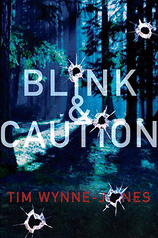
Philip Marchand reviews Tim Wynne-Jones's Blink & Caution for the National Post The Afterword page. Marchand discusses what makes a novel YA in the review.

Susan Carpenter reviews Brandon Mull's Beyonders in The Kansas City Star.


And here's a kid-review of a YA title in the Guardian: SophieDophie writes about My Sister Lives on the Mantelpiece, by Annabel Pitcher.

Meneesha Govender reviews Jennifer Lynne Barnes's Raised by Wolves for IOL (South Africa):  ("Raised by Wolves is packed with intriguing and supernatural escapism that should have many teen readers hooked. I wonder if it’s going to become a new hit series?")

Pam Norfolk reviews John Grisham's YA novel Theodore Boone: Half the Man, Twice the Lawyer for The Clitheroe Advertiser and Times.


Susan Carpenter considers Blake Nelson's Recovery Road and Nic Sheff's We All Fall Down for The Los Angeles Times' "Not Just for Kids" column.  ("A novel and a memoir teenage drug addiction and rehab is seen from the addict's perspective.")

Alice Jones reviews Godspeed: The Kurt Cobain Graphic for The Independent.


Here's a review of the adult-->YA Crossover Title I'm listening to now: Judy Romanowich Smith talks Kate Morton's The Distant Hours for The Minneapolis-St. Paul Star Tribune.  ("A tale of pure mystery and delight.")


Mary Harris Russell reviews a younger YA title, Angel in my Pocket, by Ilene Cooper, in The Chicago Tribune.  Harris Russell also provides a capsule review for Shaun Tan's Lost and Found with John Marsden's The Rabbits.

Weekend (and Crossover) News

I know it's already Tuesday, but a busy weekend leads to a late news roundup.  Better late, than never, I hope!  Here's the "news" from March 14-20:

Corey Wittig talks Alex Awards in The Pittsburgh Post-Gazette.


Sarah Pekkanen writes of girls and boys and the gender divide in children's and teen books for The Washington Post. She begins with a discussion of Forever, a book my students will be blogging about soon.

Kimberly Morgan discusses "More Than Just Vampires and Wizards: Why Young Adult Fiction is Worth Your Time and Money" for Yahoo's Associated Content network.

I don't know about you, but I loved coloring books as a teen--especially intricate ones designed for adults.  Maria Popova reviews five such coloring books for The Atlantic.


Check out the finalists for the Lambda Literary Award here at School Library Journal.

Don't miss Sally Lodge's interview with Cheryl Klein on the publication of Second Sight: An Editor’s Talks on Writing, Revising, and Publishing Books for Children and Young Adults in School Library Journal.


You will find lots of YA and Crossover titles recommended by Philip Pullman, Michael Morpurgo, Katy Guest, John Walsh, and Michael Rosen in "The 50 Books Every Child Should Read" article in The Independent.


Adrian Chamberlain profiles YA novelist Susan Juby on the occasion of the publication of her first adult novel, The Woefield Poultry Collective, for The Times-Colonist (Victoria & Vancouver Island).


Aric Davis, who has previously written thrillers for adults, takes on YA with Nickel Plated and thinks about the boundaries of violence when writing for teens. (In the Wall Street Journal SpeakEasy blog.)

Sunday, March 13, 2011

Weekend (and Crossover) Reviews

Susan Carpenter reviews Brandon Mull's Beyonders for the Los Angeles Times's "Not Just for Kids" column.

Bill Eichenberger reviews David Halperin's Journal of a UFO Investigator: A Novel for the Pittsburgh Post-Gazette. ("...as much a philosophic treatise as it is a voyage through fantastical worlds")

Summer Moore considers the seventh in James Patterson's Maximum Ride series Angel in the Winston-Salem Journal. (..."a strong installment in the series. It is full of fight scenes mixed with puppy love and many fantastic flying descriptions that will make readers wish they had wings.")

Sharon Galligar Chance reviews Ireland-centered books, one of them a Young Adult title (The Book of Tomorrow, by Cecelia Ahern), for the Ventura County Star. ("Ahern, who is the daughter of the former prime minister of Ireland, is well known for her sassy, brassy, chick-lit novels, and "The Book of Tomorrow" is no exception to the rule.")

Jodi Delong reviews a flipbook ("...two stories, back to back... you read one story by one author, and then flip the book over to read the second story") for teens by Christy Ann Conlin for The Chronicle Herald (Halifax).

Darcey Steinke reviews Judy Blundell's Strings Attached for the New York Times.


Meghan Cox Gurdon reviews Tim Wynne-Jones's Blink & Caution for the Wall Street Journal.  Gurdon finds the book good, but objects to some of the language and imagery: "...perhaps because the book is so skillfully wrought, one wishes that it could have been written without not just foul language but also foully specific images, such as that of a 16-year-old girl sleeping with a sadistic drug dealer." Hmmm....I'm putting Blink & Caution next on my crossover-reading list.

Graham Moore reviews the new Sherlock Holmes YA, Death Cloud, by Andrew Lane for the New York Times. (The NYT is a bit behind with their YA reviews this month.  Strings Attached and Death Cloud have been reviewed elsewhere for weeks.  Oh, but here's a new title: Pamela Paul takes a look at Deadly, by Chibarro, in the Children's Bookshelf column: "...the rare Y.A. novel in which a girl’s intellectual interests trump adolescent romance.")

Karen MacPherson reviews books for kids with disability themes for abcactionnews.com.  Two of the titles MacPherson discusses are Jordan Sonnenblick's After Ever After and Antony John's Five Flavors of Dumb.


Molly Fischer considers Tea Obreht's The Tiger's Wife in the The New York Observer. Fischer begins the review with "A young-adult novel is like porn: hard to define, but you know it when you see it" and compares The Tiger's Wife, which has been reviewed positively elsewhere, to a children's or YA novel in its structure and themes.  In other words, a crossover book, but not in a good way, at least according to Fischer.

Christy Ann Conlin (whose own YA novel was reviewed this week by Jodi Delong and cited in this post) reviews Michelle Paver's first adult novel Dark Matter: A Ghost Story for The Globe and Mail.  (Paver is the author of the Chronicles of Ancient Darkness series.)

Weekend (and Crossover) News

For the teens who loved Hardwicke's Red Riding Hood, there are tie-ins available: Liesl Bradner highlights Daniel Egneus's seriously-beautiful illustrated version of Little Red Riding Hood for the Los Angeles Times Jacket Copy blog and Susan Carpenter tells of the ebook version of the Red Riding Hood film written by Sarah Blakley-Cartwright, also in the Los Angeles Times.


Lee Wind interviews Jodi Picoult for SheWired.com.  Wind asks, "you have a huge teen and young adult following...Does awareness of your teen readers shape your writing?"  And Picoult answers:
I love my teen fans. First of all, they're not shy. They write me all the time and talk about how much they enjoy my books, and who wouldn't like that kind of feedback!?...I love teen narrators because they have a built-in BS meter. They won't let you get away with a lie; they always cut to the heart of the matter. 
This is an excerpted question and answer.  Don't miss the entire exhange!

Last week I linked to an interesting article on teen books today in India, and this week there's a fascinating article on feminist publishing in India and its growing success on livemint.com (&The Wall Street Journal).  One feminist house, Zubaan, has a new imprint for children ("upt to teens") called Young Zubaan.  Commissioning Editor Anita Roy says this is foucs is due to the fact "children’s books in India are conservative, preachy, derivative and just not very good."

Tad Vizner profiles Amanda Hocking, the young writer who made tons of money selling her YA fiction in self-published ebook format, for TwinCities.com. Interestingly, Hocking credits bookbloggers, to whom she sent print-on-demand copies of her books, with her early success.

Do you want your teen or tween to read "great books" they haven't read in school?  Then check out this article on "Great Books Camp" in The Christian Science Monitor.


Marlene Charnizon rounds up what teens are checking out from public libraries for The School Library Journal

Monday, March 7, 2011

What I Liked in 2010 (Part II)


Um, it's March 7, and I probably should be moving on...but here's the second part of my What I Liked in 2010 (the year I read only adult fiction) post.

John le Carre continues to have something new to say with each novel. Our Kind of Traitor is particularly interesting because le Carre has not missed the changes that have occurred in the former Soviet Union and beyond its borders where many of its former citizens live. The young British protagonists of Our Kind of Traitor stumble into a Russian "family" living in Switzerland and end up being hired to broker a deal with the wealthy leader of this clan on behalf of the British government. To the end of the novel it is not clear who is good and who is bad, who is moral and who is amoral, and the protagonists are both drawn to and repelled by the Russian family with whom they negotiate.

Crossover Potential? Some. This novel might appeal to the teen well versed in spy novels, but Our Kind of Traitor is a quiet spy novel, concerned more with moral ambiguity than with high-pressure negotiations and chase.

Ian McEwan's Solar was the funniest book I read in 2010. McEwan's protagonist, Michael Beard, is a Nobel prize winner in Physics and a mess. As the book opens, he's losing his fifth wife to his builder. This humiliation leads him to accept an invitation to the Arctic, where he nearly loses his penis when peeing outdoors. (Strangely enough, Solar was one of two books from 2010 featuring grave penile injury.) After his return home, Beard accidentally kills someone, steals his scientific work (on purpose), and heads out on a series of misadventures, one of which involves a solar energy project in Arizona. Other women, a child, and disastrous business deals ensue. Beard is a loathsome character, but one absolutely worth following to the bitter end.

Crossover Potential? Not really. But if you're an adult, don't miss Solar.


Lionel Shriver's So Much for That is one brutal book. Shriver takes an unflinching, merciless look at health care in the U.S. through the lives of two couples--Shep and Glynis Knacker and Jackson and Carol Burdina. Shep dreams of escaping the U.S. with the money he made from selling his business when he learns that his wife has mesothelioma. The novel marks time by the shrinking of Shep's escape fund, dollar by dollar, as he cares for his "insured" wife. Jackson and Carol parent a chronically ill and disabled daughter, whose care takes up all their resources and time. This is not the stuff of happy marriages, happy families, and happy novels. (So Much for That is the second novel of 2010 in which penile injury plays a significant role.) Despite, or perhaps because of, the trauma it inflicts, So Much for That is a novel that makes you think. I loved its brutality and its honesty.

Crossover Potential? Honestly? I don't think anyone younger than 40 should read this book.

My favorite novel of 2010 was Gary Shteyngart's Super Sad True Love Story. Set in the near future, when everything about one's life (cholesterol levels, weight, credit score) is available for the world to see and when immortality is nearly achievable, Super Sad True Love Story is narrated by hapless lovers Lenny Abramov and Eunice Park. Abramov is the 39-year-old son of Russian-Jewish immigrants who works for an international corporation in the business of keeping people young. Park is in her early 20s, and after a stint in Italy is not sure what she is going to do with her life. Park and Abramov end up together, Abramov more invested in the relationship than Park. Super Sad True Love Story is indeed a sad story about the collapse of America, the futility of clinging to youth, the emptiness of consumerism, and the weight of an endless stream of information. But it is, in the end, a love story narrated by two compelling individuals unable to overcome body, history, generation, and time.***

Crossover Potential? Some. Shteyngart gets Eunice Park's voice just right. She sounds like a young adult and lives as a young adult might a few decades into the future.

Everyone loved Jennifer Egan's A Visit from the Goon Squad. Heck, Judy Blume tweeted her appreciation for Egan's innovative novel just today. Told in a variety of voices and from different points in time, A Visit from the Goon Squad has its genesis in the 1970s music scene in San Francisco. It's difficult to describe Egan's novel, as the story and the storytellers shift locations, relationships, and places in time. Time, ultimately, is the center of Goon Squad--a center that can't be fixed.

Crossover Potential? Some. I think teens will appreciate Egan's approach to telling a story. In particular, I think they will find the concluding power point presentation intriguing.
------------------------------------
NOTES
------------------------------------
*** I listened to Shteyngart's Super Sad True Love Story. This is a good choice for audio; Voice is the strength of the novel. However...bad accents in audio books drive me crazy. I really only know Russian well enough to be annoyed by how badly it is rendered in an audiobook, but if the Russian drives me crazy, I can only guess how badly Chinese, or German, or any other language is spoken in audio. Why don't publishers hire people to read who actually speak the other language present in the book? Why? Why don't they?
-----------------------------------
Okay, I am truly done with 2010. Time to move on. This week I will finally get to the mission of this blog and review YA fiction from Mal Peet that adults should read and two adult novels by Heather Gudenkauf teens will love.

Sunday, February 27, 2011

Weekend (Teen/Crossover) Book News

In starting up the Weekend Reviews again I am finding that there are as many news stories about teen and crossover books as there are reviews in the mainstream media.


Ian Crouch brings us up to date on the case against Leonora Rustamova (U.K.) in The New Yorker. Rustamova wrote, with her teenaged students, a self-published novel called Stop! Don't Read This, a book in which teen-aged boys, "named after and resembling her students, sell cocaine, skip school, and, at one unfortunate point, practice 'orgasmic moans' that sound like 'the soundtrack to teenage gay porn.'"